Process Maturity
Effective product development requires coordination across three groups—Product, Design, and Development—working from a shared understanding of why, what, and how.
People
Product
Product Manager, Analysts, Executives
Responsible for the why: defining business goals, aligning stakeholders, and ensuring the product makes strategic sense.
Design
UX Designers, UX Researchers, Discovery Coach
Responsible for the what: understanding user needs, exploring solutions, and validating that designs meet those needs.
Development
Developers, Validators, Architects, Scrum Master
Responsible for the how: building, integrating, and releasing software that implements the validated designs.
Benefits of a Coordinated Process
When these groups work together through a structured process, the benefits extend across the organization:
For the Team: Shared understanding of user needs and business goals, improved motivation, better communication.
For the Product: Build the right thing, improve quality, reduce waste, enable continuous improvement.
For the Business: Compelling product vision and strategy, accomplish priority goals, stay on time and budget, reduce risk.
For the Customer: A solution that is valuable, usable, enjoyable, and desirable.
Discovery Process
Discovery happens before development begins. Its purpose is to figure out—and validate—what to build. The process moves through four phases, alternating between expansive exploration and focused decision-making.
Pre-Discovery
Determine stakeholders and compile a foundation of research for quick reference during discovery.
This is an opening phase—gather broadly before narrowing.
Gather
- Research findings
- User interviews
- User task analysis
- Market research
- Business needs and goals
- Existing technical architecture
Guiding Questions
- Who are our customers, stakeholders, and subject matter experts?
- What problems do they face?
- What opportunities should we explore?
- Do we have the people, shared understanding, and support we need to be successful?
- Where will we store our knowledge?
Customer Discovery
Understand our users to make sure we build something they will find valuable.
This phase focuses and synthesizes—distilling research into a clear picture of user needs.
Tasks
- Review research findings
- Discover user's point of view: user types, needs and goals, current workflows and task flows, pain points and opportunities
- Define success criteria
Guiding Questions
- Who are the types of users of this product?
- What is valuable to our users?
- How are users currently meeting their needs?
- What challenges and conflicts do users face?
- What changes in user behavior would demonstrate success?
Product Discovery
Ideate solutions, establish design criteria, and explore technical feasibility to decide what to build first.
This is an expansive phase—generate multiple possibilities before converging on a direction.
Tasks
- List product capabilities needed
- Ideate multiple solutions
- Create conceptual models
- Conduct technical discovery (development and integration planning)
- Identify risks and mitigations
Guiding Questions
- What should we build first?
- Is it valuable—will it help users meet their goals?
- Is it feasible—can we build it?
- Is it viable—does it make business sense?
- What do we still need to learn, and how will we decide?
Initial Design
Use an iterative design process with continuous feedback to validate the solution meets user needs.
This phase narrows to decisions—testing and refining until designs are ready for development.
Tasks
- Create conceptual designs (wireframes)
- Create detailed designs (prototypes)
- Conduct ongoing usability testing
- Identify the MVP
- Build the initial Product Backlog
- Build the initial Idea Backlog
Guiding Questions
- Is it usable—can users figure it out?
- Does it meet user needs?
- Does it cause the behavior changes we intended?
- Does it still make business and technical sense?
- What should we consider designing after the MVP?
Backlogs
Two backlogs coordinate work between Design and Development.
Idea Backlog
A list of ideas for features we could build to meet user needs. Ideas are evaluated against four criteria:
- Valuable: Does it solve a customer need?
- Viable: Will it work for the business?
- Usable: Can customers figure out how to use it?
- Feasible: Can we build it?
The Idea Backlog is owned by Design and fed by learnings from both design testing and post-release feedback.
Product Backlog
A list of features we need to build to meet the design criteria. Items are evaluated against four criteria:
- Effective: Does it technically work?
- Aligned: Does it match the design?
- Functional: Is it efficient?
- Adaptable: Is it easy to change later?
The Product Backlog is owned by Development and fed by validated designs from the Design track and technical learnings from released software.
Dual-Track Development
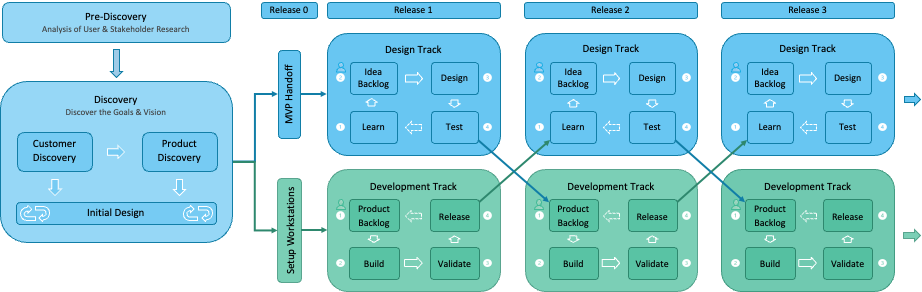
Once the initial discovery and design work produces an MVP handoff, development begins and the two tracks run in parallel. This approach is called Dual-Track Agile.
The Two Tracks
Design Track and Development Track operate simultaneously, each with its own iterative loop.
Design Track: Learn → Idea Backlog → Design → Test
The Design track cycles through learning, prioritizing, designing, and testing. Testing provides raw data from which to learn how to iterate on the design. After going through this loop, a validated design moves into the Product Backlog for development.
Development Track: Product Backlog → Build → Validate → Release
The Development track cycles through building, validating, and releasing. Technical learnings from the release—such as performance issues or infrastructure needs—feed back into the Product Backlog. User experience learnings from released software—such as usage metrics and customer feedback—flow back to the Design track's learning process.
Release 0
Development sets up workstations and infrastructure. Design hands off the MVP—the first set of validated designs moves into the Product Backlog.
The Rhythm
Design stays one release ahead of Development. While Development is building Release 1, Design is testing and refining work for Release 2. This creates continuous flow without blocking either track.
The feedback loops are essential: what we learn from testing designs and what we learn from released software both inform what we design next. The backlogs aren't just queues—they're where different types of learning converge and get prioritized.